Below is my deep and consonant convo with Sam (www.selfrealization.blog). We cover the topics of different spiritual paths, eternal presence, and spiritual validation through peace, among many other fascinating topics.
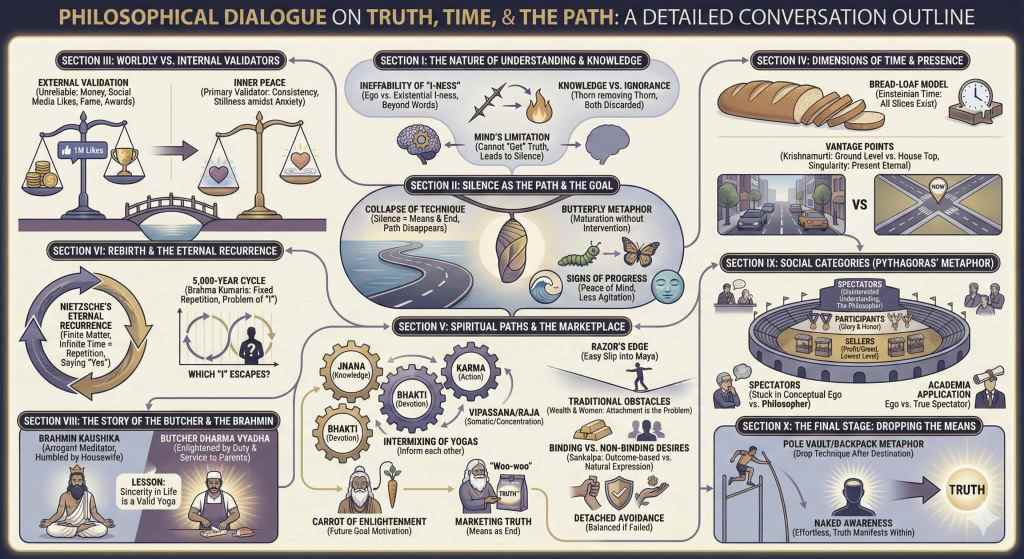
The Nature of Understanding and Knowledge
- The Ineffability of “I-ness”
- Difficulty expressing the difference between the ego “I” and the existential “I-ness.”
- The problem of using words to describe a state beyond words.
- Knowledge vs. Ignorance
- Knowledge is often just a “thorn” used to remove the “thorn” of ignorance. Once removed, both must be discarded.
- Knowledge resides in the mind (words, concepts, duality).
- Truth is formless, non-dual, and cannot be contained by words.
- The Mind’s Limitation
- The mind cannot “get” to truth because truth is not a destination for thought.
- The realization that the mind is futile leads to silence.
II. Silence as the Path and the Goal
- The Collapse of Technique
- Silence is both the means and the end.
- Once in silence, the concept of a “path” (e.g., “I have come 12 miles toward the goal”) disappears.
- The Butterfly Metaphor
- A caterpillar cannot do anything to become a butterfly; it must allow time for maturation.
- Similarly, one must allow silence to work without intervention.
- Signs of Progress
- Progress is not measured by external achievement but by the “peace of mind” and “less agitation.”
III. Worldly vs. Internal Validators
- The Unreliability of External Validation
- The “Validators of the World”: Money, social media likes, fame, and awards.
- The irony of “likes”: Profound truths get little attention, while trivial or “stupid” content receives massive engagement.
- Inner Peace as the Primary Validator
- Consistency of inner peace becomes the only reliable indicator of being “on the path.”
- Maintaining stillness even when experiencing external anxiety, anger, or depression.
IV. Dimensions of Time and Presence
- The “Bread-Loaf” Model of Time (Einsteinian perspective)
- Time as a pre-existing structure where all slices (past, present, future) already exist.
- We are not going through time; we are discovering what is already there in the eternal moment.
- Vantage Points (Krishnamurti perspective)
- Ground Level: Seeing a car pass but not knowing what is on the next street.
- High Level (The House Top): Seeing two cars approaching from different directions and knowing they will meet.
- The Singularity: Moving from the linear “past/present/future” to a “present eternal” outside of time center of gravity.
V. Spiritual Paths and the Marketplace
- The Intermixing of Yogas
- Jnana Yoga (Knowledge/Understanding).
- Karma Yoga (Selfless Action).
- Bhakti Yoga (Devotion).
- Raja Yoga (Discipline)
- Vipassana falls into the Jnana Yoga Path.
- Paths are not isolated; they inform and illuminate each other.
- The “Carrot” of Enlightenment
- Teachers often dangle the carrot of “future enlightenment” to keep students motivated.
- The danger of “Woo-woo” gurus: Packaging inbuilt truth into a “saleable” product.
- Marketing the path as a means to an end rather than the end itself.
VI. Rebirth and the Eternal Recurrence
- Nietzsche’s Eternal Recurrence
- The logical puzzle: If matter is finite but time is infinite, all configurations of matter must repeat.
- The challenge: Can you say “Yes” to life even if it repeats exactly forever?
- The 5,000-Year Cycle (Brahma Kumaris Doctrine)
- Discussion of a fixed cycle where everything repeats to the “T.”
- The debate on whether “I” can reinvent my role in the next cycle through current purification.
- The Problem of “I” in Rebirth
- If one escapes rebirth, what is the “I” that is escaping?
- The difficulty in connecting the “suffering I” of one life to the “liberated I” of the next.
VII. Traps and Safeguards on the Path
- The “Razor’s Edge”
- The Path of Knowledge is as thin as a razor’s edge; it is incredibly easy to slip back into Maya (illusion/ignorance).
- The contrarian view is that there is no slipping, no mistakes, ultimately. It’s all part of the growth process.
- Traditional Obstacles: Wealth and Women (Dhan/Stree)
- Discussion on whether marriage and sexuality are traps or simply parts of the human experience.
- Perspective: The act itself is never the problem; it is the attachment to the pleasure or the thought of the act afterward.
- Binding vs. Non-Binding Desires (Sankalpa)
- Binding: Seeking personal happiness/fulfillment through an outcome.
- Non-Binding: An expression of one’s nature (like a happy person wanting to dance).
- Detached Avoidance: It is okay to avoid sickness/trouble as long as you remain balanced if you fail to avoid it.
VIII. The Story of the Butcher and the Brahmin (Dharma Vyadha)
- The Parable from the Mahabharata
- A Brahmin (Kaushika) becomes arrogant about his meditative powers.
- A housewife knows his thoughts without being there, humbling him.
- She sends him to a butcher (Dharma Vyadha) for the highest teaching.
- The Lesson:
- The butcher, despite his “lowly” profession, reached enlightenment by sincerely doing his duty (Dharma) and serving his parents.
- Formal study and renunciation are not the only paths to truth; sincerity in life is a valid “Yoga.”
IX. Social Categories (Pythagoras’ Metaphor)
- The Three Spectators of the Olympic Games
- Category 1: The Sellers. Those there for profit/greed (lowest level).
- Category 2: The Participants. The athletes seeking glory and honor.
- Category 3: The Spectators. Those watching disinterestedly to understand and enjoy (The Philosopher/Brahmin).
- Application to Academia:
- Discussion on whether academics are true “spectators” or just seeking the “glory” of tenure and awards.
- Academics may be more “stuck” in the ego than business people because their rewards are more conceptual (in their head) than tangible.
X. The Final Stage: Dropping the Means
- The Pole Vault/Backpack Metaphor
- Techniques (Vipassana, Jnana) are like a pole vault or a heavy backpack.
- Once you clear the bar or reach the destination, you must drop the tool.
- Carrying the “boat” after crossing the river is a burden.
- Naked Awareness
- Eventually, even the “effort to be still” is dropped. Awareness becomes natural and effortless.
- Truth manifests within; there is nothing left to pursue.
Ranjeeth Thunga
Perspective Mapper