Based on the transcript provided, here is an extensive documentation of the meeting between D Samarender Reddy and Ranjeeth (The Perspective Mapper) on New Year’s Eve 2025.

Meeting Overview
- Date: Friday, Dec 31, 2025.
- Location: Hyderabad, India. The meeting begins outdoors (likely a park or walking path) and transitions to a Third Wave Coffee outlet.
- Context: A recorded philosophical dialogue/peripatetic walk that serves as a “sign-off” for the old year and a welcome to 2026.
- Atmosphere: Highly intellectual yet irreverent and humorous. The conversation is characterized by rapid-fire exchanges, mutual roasting, inside jokes regarding mutual acquaintances, and deep metaphysical exploration interspersed with mundane logistics (ordering coffee).
Part 1: The Nature of Philosophy & Thinking
The discussion begins with Sam deconstructing the concept of “Philosophy.”
- Philosophy as Thinking: Sam argues that before academic categories (sociology, political science) existed, men simply “thought.” He posits that philosophy is merely “thinking underway” to solve problems.
- The Rejection of Philosophy: Ranjeeth notes that even people who claim “I am not a philosopher” are actually stating a philosophy. To dismiss philosophy is, paradoxically, a philosophical stance.
- Purpose: Sam states his purpose in life is “to make people think more deeply about life,” rather than accepting societal, biological, or psychological defaults.
Part 2: Truth, Silence, and Communication
A significant portion of the dialogue focuses on how—and if—truth can be communicated.
- The Trap of Words: Sam suggests that the only language capable of expressing “whole truth” is silence. Once truth is put into words, it becomes a “half-truth” or a specific perspective dependent on the receiver’s capacity to understand.
- “Casting the Net”: Ranjeeth counters that while silence is potent, one must still “cast the net” (speak) because occasionally, the truth does land, even if unexpectedly.
- The “Reader Response” Theory: Sam references literary theory, noting that once a text (or speech) is released, the author loses control. The meaning is generated by the reader/listener based on their own biography and prejudices.
- The Leaf Metaphor: Perspective Mapper discuss a story about the Buddha holding up a single leaf. While the forest represents all truth, the single leaf represents the truth that is relevant to the specific moment and person.
Part 3: East vs. West (Psychology vs. Spirituality)
The duo explores the dichotomy between Western psychological approaches and Eastern spiritual traditions.
- The Western Approach: Ranjeeth notes the West focuses on “becoming,” self-improvement, and psychology. They critiques Western academia for often lacking the “spiritual component” and focusing too heavily on “intellectual justification of the status quo” (a Marxist critique).
- The Eastern Approach: Perspective Mapper critiques the Indian context for being emotionally repressed. They both discuss how Indians often lack “Emotional Quotient” because religion is used as an opiate to bypass resolving emotional conflicts. They simply “offer it to God” rather than communicating difficult feelings.
- Mental Illness:
- Sam quotes R.D. Laing, suggesting mental illness is a “sane response to an insane society.”
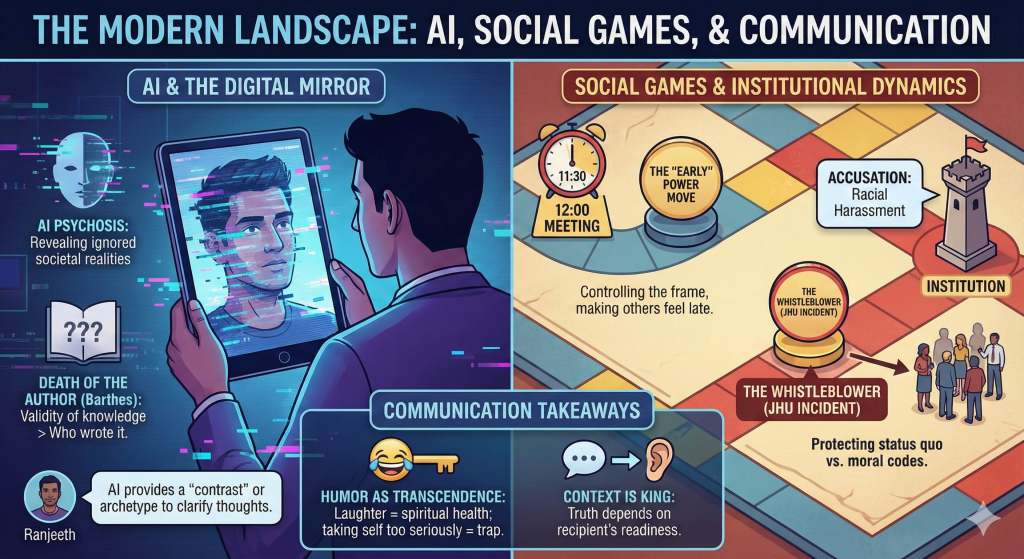
- Perspective Mapper brings up “AI Psychosis,” suggesting AI is revealing parts of reality that mainstream society ignores, causing a fracture in the collective psyche.
- They discuss the “Ghost in the Machine” concept—whether the soul exists or if it’s just a “category error” (referencing philosopher Gilbert Ryle).
Part 4: Ego, Identity, and “Nano-Enlightenment”
They engage in a meta-discussion about their own egos and the nature of enlightenment.
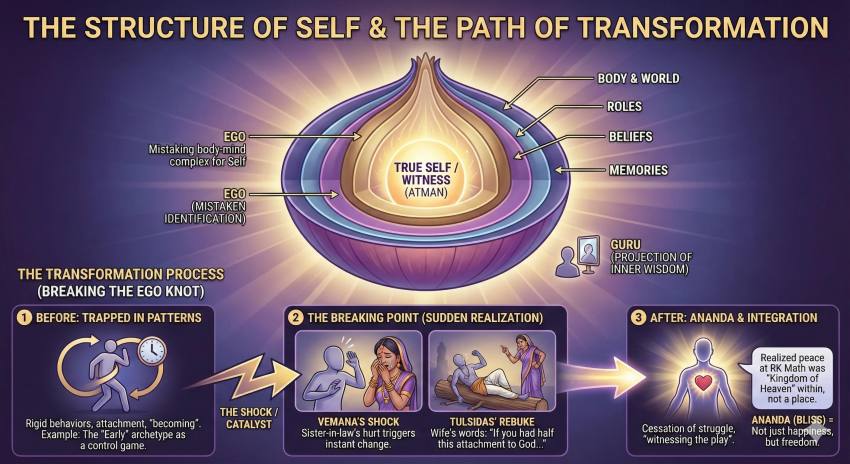
- Defining Ego: Sam defines ego not as arrogance, but as the mistaken identification of the self with the body-mind complex.
- “Nano-Enlightenment”: Ranjeeth joikingly coins the term “Nano-enlightenment” (or “Micro-enlightenment”) to describe fleeting moments of clarity and joy amidst the chaos of life, mocking the grandiosity of permanent enlightenment claims, as well as the act of coining and claiming new words.
- The Role of the Guru: They agree that a Guru is often just a projection of the seeker’s own inner wisdom (the “lion in the elephant’s dream”).
- Lila (Divine Play): They conclude that life is Lila—a play. The goal isn’t necessarily to stop the play, but to realize it is a play. Sam notes that suffering occurs when one takes the role too seriously; joy (“Ananda”) comes from witnessing the play.
Part 5: Artificial Intelligence & Authorship
Ranjeeth reveals he has been using ChatGPT to analyze their conversations and even his own psychological profile.
- The AI Mirror: Ranjeeth notes that AI provides a “contrast” or “archetype” that helps clarify their own thoughts.
- Death of the Author: Sam argues that in the age of AI, who wrote a text matters less than the validity of the knowledge itself. He references Roland Barthes’ “The Death of the Author.”
- Humor: They joke that they might become “experts in AI” without knowing anything technical, simply by philosophizing about it.
Part 6: Personal Anecdotes & The Case Study
Throughout the talk, they reference a mutual acquaintances for contrast.
- The Foil: They serves as a recurring case study for them—those who represent resistance to philosophical thinking, adherence to rigid timelines, and a lack of “chill.”
- The Lesson: Sam suggests they are a mirror for our own patience. Ranjeeth admits their behavior can irritate them, but with maturity, now views it with more amusement or detachment.
Part 7: Logistics & Setting (The Cafe)
- Venue: They arrive at Third Wave Coffee.
- Celebration: They note the lack of traditional New Year’s celebration (booze/partying), preferring this intellectual “celebration” instead.
Key Conclusions / “Takeaways”
- Context is King: Truth is not absolute in communication; it depends entirely on the context and the recipient’s readiness.
- Love Thy Neighbor: The foundation of ethics and politics should be simple (Golden Rule), yet intellect complicates it.
- Integration: The ideal path merges the Western focus on psychological health/individuality with the Eastern focus on transcendence/oneness.
- Humor as Transcendence: Laughter is a sign of spiritual health; taking oneself too seriously can be a spiritual trap.
Here is a continuation of the documentation, focusing on specific anecdotes, detailed philosophical references, and the humorous interplay that characterized the latter half of the meeting.
Addendum: Detailed Anecdotes & Narrative Arcs
1. The Johns Hopkins “Whistleblower” Incident
Ranjeeth recounts a specific event from his time at Johns Hopkins University (JHU) that defined his feeling of being an outsider or “scapegoat.”
- The Incident: During a Martin Luther King Jr. Day celebration, he noticed that the housekeeping staff—who were predominantly Black—were not invited to the festivities.
- The Action: He raised this issue, asking, “Shouldn’t the housekeeping staff be invited?”
- The Fallout: Instead of being praised for inclusivity, the department accused him of “racial harassment” for bringing it up.
- Significance: Ranjeeth uses this story to illustrate how institutions (like the “Ivory Tower” of academia) often protect the status quo rather than living up to their stated moral codes. Sam interprets this as Ranjeeth playing the role of the “unwelcome truth-teller” or whistleblower.
2. The Transformation Stories (Vemana & Tulsidas)
To illustrate the concept of sudden transformation (or “breaking the ego knot”), Sam shares two classical Indian stories:
- Yogi Vemana: Originally a hedonist in love with a courtesan named Vishwada, Vemana was constantly exploited for money. When he stole his sister-in-law’s jewelry to pay the courtesan, his sister-in-law’s hurt reaction triggered a sudden realization in him. He walked away from that life instantly to become a great poet-saint.
- Tulsidas: He was so attached to his wife that he once crossed a flooded river on a corpse (mistaking it for a log) and climbed a black cobra (mistaking it for a rope) just to see her. His wife rebuked him, saying, “If you had half this attachment to God, you would be enlightened.” This shock converted him instantly into the saint who wrote the Ramcharitmanas.
3. The Case Study (The Power of Being Early)
The recurring character is a psychological archetype.
- The “Early” Power Move: Ranjeeth describes how the character inevitably arrives at meetings 30 minutes early. If they agree to meet at 12:00, they arrive at 11:30.
- The Dynamic: This causes the other person to feel “late” even when they are on time. Ranjeeth admits this used to make him feel guilty or rushed, but now he sees it as a “game” they play to establish control the frame of the interaction. Sam calls it a “game people play” (referencing Eric Berne’s transactional analysis).
4. The “Kingdom of Heaven” Debate
Sam recounts a recent interaction with a friend regarding a visit to the Ramakrishna Math (RK Math).
- Context: It was Vaikuntha Ekadashi (a holy day). They insisted they go to the temple because “the doors of heaven are open today.”
- Sam’s Retort: He cynically replied, “I don’t want to go to heaven, nor do I want to go to hell. I don’t want to exist after death.”
- The Realization: Later, sitting in the RK Math listening to bhajans, Sam felt a profound peace. He realized that this peace was the “Kingdom of Heaven” within him, and that the friend’s external ritual was just a pointer to this internal state. He regretted his earlier cynicism, noting that intellectualizing often blocks the experience of “Bhakti” (devotion).
Extensive Reference List
The dialogue was dense with intertextual references. Here is a catalog of the specific thinkers and concepts cited:
- Philosophers & Thinkers:
- Bertrand Russell: Cited on the inevitability of philosophy (“Everyone is a philosopher; only some do it poorly”).
- Gilbert Ryle: Referenced regarding the “Ghost in the Machine” and “Category Errors” (The Concept of Mind).
- Antonio Gramsci: His distinction between “Traditional Intellectuals” (academics protecting the system) vs. “Organic Intellectuals” (those rising from a class to articulate its struggles).
- Karl Marx: Referenced regarding the economic “base” determining the cultural “superstructure” (religion/philosophy as justification for the status quo).
- R.D. Laing: Cited for the idea that “insanity is a sane response to an insane society.”
- J. Krishnamurti & U.G. Krishnamurti: Contrasted heavily. JK as the serious, groomed “World Teacher” vs. UG as the cynical “trash talker” who denies the existence of a soul or enlightenment.
- Andrew Cohen: Mentioned for his concept of “Evolutionary Enlightenment.”
- Plutarch: Mentioned for his biographical work Parallel Lives (comparing Greek and Roman figures), which Sam jokingly suggests Ranjeeth should emulate by comparing Indian and Western thinkers.
- Texts & Concepts:
- “Lice, Damn Lies, and Statistics”
- “The Death of the Author” (Roland Barthes): Used to argue that the author’s intent (or identity) is irrelevant once the text is released—especially relevant in the age of AI-generated text.
- Neti Neti: The Vedic practice of negation (“Not this, not this”) used to describe the process of peeling away false identities (ego).
- Ananda (Bliss): Sam clarifies that true bliss isn’t just happiness, but the cessation of the struggle to “become.”
Setting the Scene: The Cafe Order
The recording concludes with the mundane reality of their meeting at Third Wave Coffee, providing a grounding contrast to the high-flying philosophy.
- The “One-by-Two” Confusion: There is a detailed, slightly chaotic exchange about the “Buy One Get One” offer.
- The staff informs them the offer applies to coffee, not non coffee drinks.
- The Food: They order a Paneer Tikka Sandwich.
Humorous Highlights
- “Om Sam”: They joke that in 2026, the new mantra will not be “Om Shanti” or “Om Namah Shivaya,” but “Om Sam,” celebrating newfound confidence and “nano-enlightenment.”
- “Licking the Toad”: Ranjeeth mentions friends who sought deep healing by “licking a toad”, causing a great physiologial purging of demons from the body.
- “The Dam”: The flow of words to the opening of the Tungabhadra Dam gates—an unstoppable flood of information.
Final Note: The meeting stands as a testament to their friendship—a “Sangha” of two—where deep metaphysical inquiry is inextricably linked with roasting each other, complaining about societal norms, and drinking overpriced coffee.