The beautiful conversation between D Samarender Reddy (Sam / DSR) (www.selfrealization.blog) and Perspective Mapper was a comprehensive exploration of Sam’s personal spiritual dilemma, meticulously analyzing the friction points between deep intellectual realization and persistent emotional suffering. The dialogue began with contrasting personal experiences and concepts, and ultimately resolved into a framework of shared consciousness and mutual recognition of distinct yet valid spiritual paths.
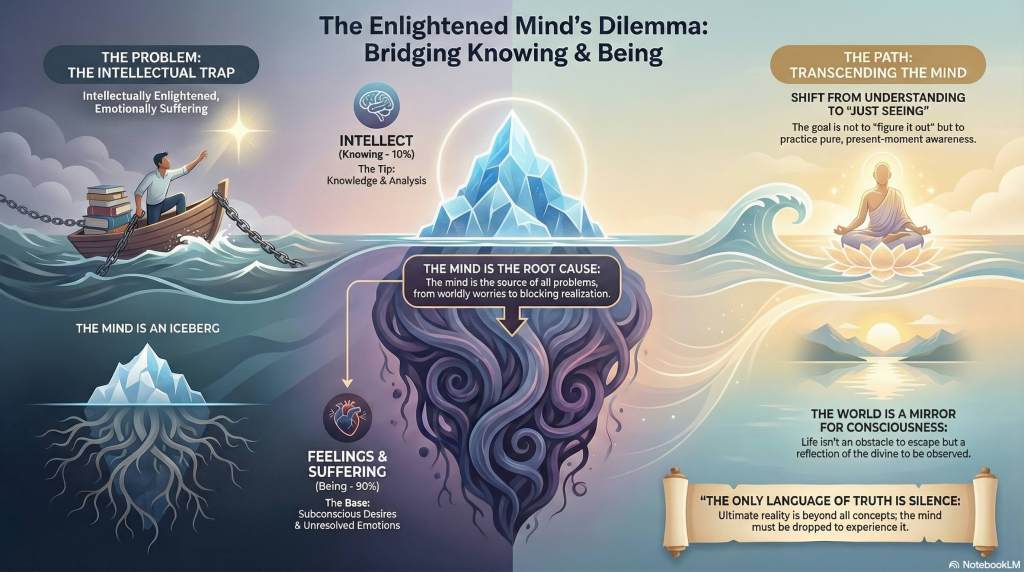
What is the cause of suffering?
What is the problem with identification?
I. Sam’s Initial Dilemma: Intellectual Freedom of the Creator is Mastery vs. Emotional Suffering
The conversation was initiated by Sam’s need to reconcile his profound philosophical understanding with his persistent emotional and existential discomfort.
Sam opened the conversation by asserting his intellectual wisdom, stating he felt “1000% clear” intellectually and believed he had nothing more to learn from spiritual teachings from Ramana, Nisargadatta, Krishnamurti, or even Ranjeeth.
This high intellectual self-assessment was the premise for Sam’s core dilemma: despite this wisdom, he still acknowledged persistent suffering on emotional and physical levels, driving the extensive conversation with Ranjeeth.
◦ Physical/Material: He constantly checked his mutual fund returns, indicating a doubt that enlightenment could sustain happiness if material well-being were lost.
◦ Emotional/Relational (The Core Problem): Sam identified relationships as the main source of suffering, stemming from others’ perceived negativity (unforgiving, judging, not recognizing the change in Sam, holding on to the image from the past about Sam, envy, jealousy) and his own unmet expectations. This emotional distress was not caused by his own negative feelings toward others, but by the negativity he sensed towards himself.
• Withdrawal and the Problem of the Other: His inability to handle relational emotions, compounded by disinterest in sociopolitical issues that preoccupied others, led him to withdraw from society. He referenced Sartre, concluding, “hell is other people,” as they serve as a reminder of one’s finitude and unknowability.
II. The Core Conflict: Paths to Truth
The discussion quickly shifted from Sam’s personal history to the fundamental mechanism of liberation, highlighting the initial conceptual differences between them.
| Sam’s Initial Position (Intellectual Focus) | Ranjeeth’s Initial Position (Experiential Focus) |
| The Mind is the Obstacle: Sam maintained that the only way to achieve both worldly happiness and spiritual enlightenment is to “drop the mind,” as the mind is the source of all problems. | Awareness is the Path: Ranjeeth introduced the practice of consistent awareness (“just seeing”), arguing that absolute truth can only be experienced, never fully understood by the mind. |
| Silence as Absolute Truth: Sam held that the only language capable of expressing the whole truth is silence, viewing all verbal explanations of creation or purpose as “local truths” or “psychological needs”. | Creation as Resonance/Mirror: Ranjeeth suggested that the belief that God created the world to see himself through us is a “phenomenological fact” that provides immediate “ease” and “consonance with source,” serving as a truth signal. |
| The Incompleteness of Love: Sam viewed intense feelings like romantic love as having a “separate life of their own” and being inherently unstable due to uncertainty and entanglement with desires and needs. | Integration of Desire: Ranjeeth advocated for integrating desires (kama and artha) according to moral constraints (dharma), noting that the satisfaction derived leads to the natural progression toward liberation (moksha). |
III. Resolution and Evolution of Perspective
The dialogue resolved when both parties recognized that their contrasting views stemmed from their distinct psychological constitutions and were merely “skillful means” to the same ultimate goal: silence.
A. Reframing the Nature of Spiritual Paths
• Duality is a Mental Construct: Sam initially challenged Ranjeeth’s focus on awareness, arguing that the need to observe or be a “silent witness” is still a subtle activity of the mind driven by insecurity. Ranjeeth countered, using the analogy that awareness is the sun and understanding is its rays.
• Sam’s Breakthrough (Dropping the Thorn): Sam eventually acknowledged the deepest insight of the conversation: his own rigid insistence on the “absolute perspective” (that only silence is truth) was itself a form of psychological attachment—the “thorn of knowledge”. He realized that maintaining this purely intellectual perspective was serving his need to be correct, and that any perspective, even the absolute one, is relative to the mind.
• The Multi-Perspective Approach: Sam adopted the understanding that both his path (withdrawal/denial of creation) and Ranjeeth’s path (engagement/creation as a mirror) are functional truths or “skillful means” that successfully reduce friction and incline the mind toward silence. This resolved the conflict, as the utility of a view is measured by its ability to aid progress, not its metaphysical correctness.
B. Understanding Awareness and Identification
• The Common Ground of Awareness: They agreed that the goal is not to eliminate thoughts, but to end identification with the body and mind. Ranjeeth’s practice of consistent awareness of breath and sensations prevents the ego from operating because “Mind is not there in that moment“. Sam recognized this practice as Nididhyasana, or Vedantic meditation—constantly dwelling on the understood truth.
• Meta-Awareness as Liberation: The practice evolved into meta-awareness (awareness of identification). They agreed that even using words like “my thought” is acceptable, provided one retains the meta-vantage point that prevents the ego from sticking to the thought. This confirmed that suffering arises only from identification, or the ignorant belief that the body and mind are oneself.
• Roles and Enlightenment: Sam realized that his current role of withdrawal and isolation, though stemming from past suffering, was a necessary path for self-understanding and peace. Both concluded that the “role we are playing has nothing to do with enlightenment,” but fulfillment of one’s path (dharma) contributes to the satisfaction needed for the eventual dropping of desire and mind.
In essence, Sam’s perspective evolved from a struggle driven by an unyielding need for intellectual completeness (“thorn of knowledge”) to an acceptance that both his suffering and his intellectual achievements were processes to be observed and transcended through continuous awareness.
Ranjeeth’s perspective was validated through Sam’s concession that the “ease” or “resonance” felt by a perspective is a key indicator of its functional truth and effectiveness in drawing one back toward Source.
Ranjeeth Thunga
Perspective Mapper