Below I present a powerful dialog I had with my dear friend Raffy Guttierez:
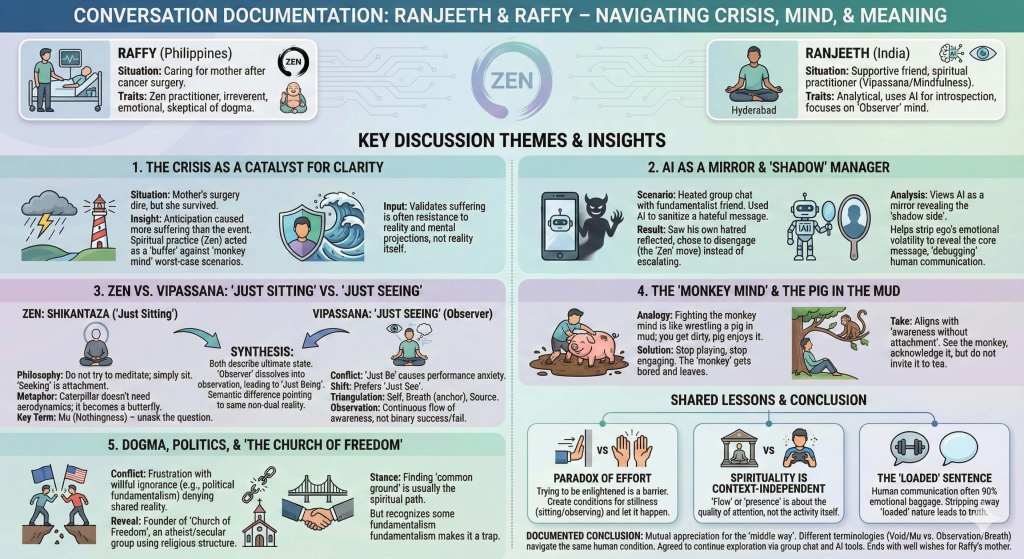
Conversation Overview
- Participants:
- Raffy: Located in the Philippines. Currently at a hospital caring for his mother, who recently underwent cancer surgery. He is a practitioner of Zen Buddhism, slightly irreverent, emotional, and skeptical of religious and political dogma.
- Perspective Mapper (Ranjeeth): Located in Hyderabad, India. A supportive friend and spiritual practitioner (likely Vipassana/mindfulness). He is analytical, uses AI for introspection, and focuses on the “Observer” mind.
- Context: A phone call checking in on Raffy’s mother. The conversation quickly pivots from the medical crisis to deep philosophical discussions on coping mechanisms, the nature of the mind, the use of AI in communication, and the differences between Zen and Vipassana meditation techniques.
Key Discussion Themes
1. The Crisis as a Catalyst for Clarity
- Situation: Raffy’s mother is recovering from surgery. The situation was dire, but she is surviving. Raffy notes that the anticipation of the event caused more suffering than the event itself.
- Perspective: Raffy admits that his spiritual practice (Zen) helped him navigate the crisis. He mentions that without the “buffer” of his practice, the suffering would have been magnified by the “monkey mind” creating worst-case scenarios.
- Ranjeeth’s Input: Validates that suffering is often a result of our resistance to reality or our mental projections, rather than the reality itself.
2. AI as a Mirror and “Shadow” Manager
- The Scenario: Raffy describes being engaged in a heated group chat with a fundamentalist Catholic friend (“Jun”) regarding religion and politics. Raffy wanted to send a vitriolic, hateful message.
- The Intervention: Instead of sending the raw message, Raffy fed it to ChatGPT. The AI sanitized the toxicity and pointed out the “loaded sentences.”
- Analysis:
- Ranjeeth: Views AI not just as a tool, but as a mirror. It reveals the “shadow side”—the parts of ourselves we try to hide. It helps strip away the ego’s emotional volatility to reveal the core message.
- Raffy: Admits that seeing his own hatred reflect back via the AI made him realize he wouldn’t sound “Zen” if he pressed send. He chose to leave the chat instead of escalating, realizing the futility of the conflict.
3. Zen vs. Vipassana: “Just Sitting” vs. “Just Seeing”
A significant portion of the call involved comparing their meditative practices.
- Raffy (Zen Perspective):
- Concept:Shikantaza (“Just Sitting”).
- The Philosophy: You do not try to meditate. You simply sit. If you are trying to achieve a state of emptiness, you are failing because “seeking” is an attachment.
- The Metaphor: The caterpillar does not need to understand aerodynamics to become a butterfly; it just needs to be a caterpillar. The understanding comes after the transformation, or the transformation renders the need for intellectual understanding moot.
- Key Term:Mu (Nothingness/Unask the question). When the mind tries to categorize, the answer is Mu.
- Ranjeeth (Mindfulness/Observer Perspective):
- The Conflict: Ranjeeth confesses that the instruction “Just Be” causes him performance anxiety. He feels he is “performing” stillness.
- The Shift: He prefers the instruction “Just See” (Observe). By becoming the Observer, he creates a triangulation: The Self, The Breath (the anchor), and The Source.
- Observation: He argues that “Just Being” creates a binary success/fail state, whereas “Just Seeing” allows for a continuous flow of awareness regarding whatever arises (breath, sensations, thoughts).
- The Synthesis: They eventually agree that “Just Sitting” (Zen) and “Just Seeing” (Vipassana) describe the same ultimate state. The “Observer” eventually dissolves into the observation, leading to the state of “Just Being.” It is a semantic difference pointing to the same non-dual reality.
4. The “Monkey Mind” and the Pig in the Mud
- Ranjeeth’s Analogy: He compares the struggling mind to wrestling a pig in the mud. If you fight the monkey mind (or the pig), you get dirty, and the pig enjoys it.
- The Solution: You stop playing. You stop wrestling. When you stop engaging with the chaotic thoughts, the “monkey” (ego/distraction) eventually gets bored and leaves.
- The Higher Take: This aligns with the concept of “awareness without attachment.” You see the monkey, acknowledge the monkey, but do not invite the monkey to tea.
5. Dogma, Politics, and “The Church of Freedom”
- The Conflict: Raffy expresses frustration with willful ignorance, specifically referencing a friend who supports the Marcos regime in the Philippines despite economic evidence of decline (40% drop in foreign investment).
- Ranjeeth’s Stance: Suggests finding “common ground” is usually the spiritual path.
- Raffy’s Rebuttal: Argues that with some forms of fundamentalism (religious or political), common ground is a trap because the other side denies shared reality.
- The Reveal: Raffy humorously reveals he is one of the founders of the “Church of Freedom,” which started as an atheist/secular group but had to adopt religious nomenclature for organizational reasons. He notes the irony of being an atheist leader of a “church.”
Insights & Takeaways
Insights from Ranjeeth
- The Semantics of Meditation: Ranjeeth realized that specific words matter. “Just Be” triggers his ego’s need to perform, whereas “Just See” triggers his natural consciousness ability to observe. Reframing the practice changed the result.
- AI as a Spiritual Tool: He sees interactions with AI as a way to “debug” human communication. If an AI points out that a sentence is “loaded,” it can be a valid critique of one’s emotional state.
- The Breath as a Gateway: He reaffirmed his reliance on breath-work not as the source itself, but as the “triangulation point” that along with sensation, connects the observer to the source.
Insights from Raffy
- The Reverse Process: Spiritual growth is not about acquiring new skills (learning to fly); it is about stripping away the barriers (the caterpillar cocooning). It is often best seen a process of subtraction, not addition.
- The Futility of “Winning”: Through the AI experiment, he realized that “winning” an argument with a fundamentalist is impossible. The only “Zen” move was to disengage (leave the chat).
- Acceptance of Suffering: He acknowledged that his mother’s condition is a part of life’s suffering (Dukkha), and his ability to navigate it without spiraling proved the value of his practice.
Shared Lessons
- The Paradox of Effort: Both agreed that trying to be enlightened is the biggest barrier to enlightenment. You cannot force the mind to be still; you can only create the conditions for stillness (sitting/observing) and let it happen.
- Spirituality is Context-Independent: Ranjeeth noted that whether one is sitting in a Zendo or playing video games (as Raffy enjoys), the state of “flow” or “presence” can be accessed. It is about the quality of attention, not the activity itself.
- The “Loaded” Sentence: Human communication is often 10% information and 90% emotional baggage. Both agreed that stripping away the “loaded” nature of words (often with the help of AI or reflection) leads to better quality communications.
Documented Conclusion
The conversation ended with a mutual appreciation for the “middle ground.” They recognized that while they use different terminologies—Ranjeeth using the language of Observation and Breath and Raffy using the language of Void (Mu) and Sitting—they are navigating the same human condition.
They agreed to continue using their group chat and AI tools to explore these philosophical concepts, potentially even gamifying the experience in the future. The call concluded with Ranjeeth sending well wishes to Raffy’s mother.
Ranjeeth Thunga
Perspective Mapper